Black Cleugh lime kiln (West Allen)
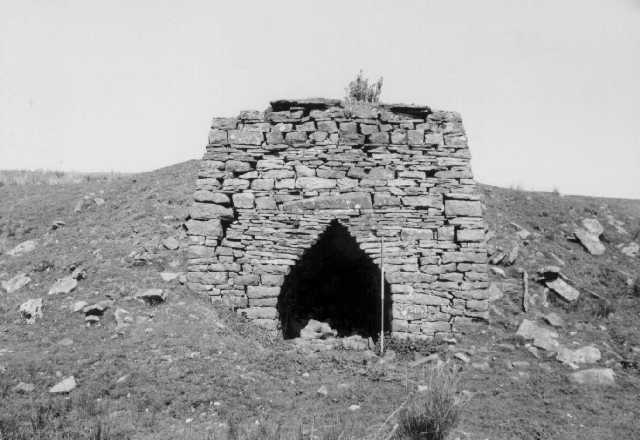
Black Cleugh lime kiln. Photo by Lancaster University Archaeological Unit.
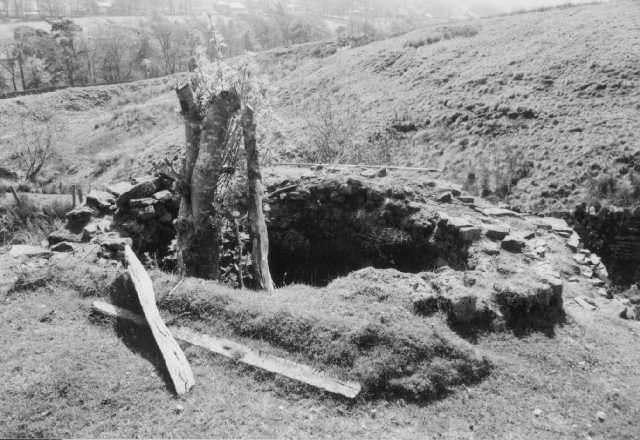
View of the pot at Black Cleugh lime kiln. Photo by Lancaster University Archaeological Unit.
Lime kiln (dis). (1)
Lime kiln in good condition, though eye has fallen away revealing the kiln. Tree growing in kiln. One pot. One draw arch, corbelled and pointed. Drystone construction. (2)
Lime kiln on north bank of Black Cleugh, Grade II. Probably early 19th century. Rubble. Square plan, built into hillside. Projecting flag cornice at head of wall. Circular pot, lined with reddened stone. (3)
Plan, two elevations and section of small limekiln with one pot and one arch. Scale 1:50. (4)
Drystone kiln on north bank of Black Cleugh. A single, quasi-ogival pointed draw arch gives way to a single collapsed eye. The pot, well-preserved and empty, is circular and 3m in diameter. The kiln is built into the hillside, square in plan, 5m square and 3.5m high. Pointed arch 2m high, 1.5m wide. Attractive and amongst the best preserved in the 2000 survey. Listed. Believed to be early 19th century. No track or other earthwork is visible. The remains of a small building stand to the north east. (5)
Old quarry. (6a)
Probably a limestone quarry associated with a lime at NY 798 481. The kiln was of dry stone construction with one corbelled pointed draw arch, with one eye. (6b)
Post medieval lime kiln, with associated limestone quarry and trackway, lying adjacent to Black Cleugh, is visible as earthwork on air photographs and still extant on the latest 2002 vertical photography, centred at NY 7981 4808. (6c)
Lime kiln in good condition, though eye has fallen away revealing the kiln. Tree growing in kiln. One pot. One draw arch, corbelled and pointed. Drystone construction. (2)
Lime kiln on north bank of Black Cleugh, Grade II. Probably early 19th century. Rubble. Square plan, built into hillside. Projecting flag cornice at head of wall. Circular pot, lined with reddened stone. (3)
Plan, two elevations and section of small limekiln with one pot and one arch. Scale 1:50. (4)
Drystone kiln on north bank of Black Cleugh. A single, quasi-ogival pointed draw arch gives way to a single collapsed eye. The pot, well-preserved and empty, is circular and 3m in diameter. The kiln is built into the hillside, square in plan, 5m square and 3.5m high. Pointed arch 2m high, 1.5m wide. Attractive and amongst the best preserved in the 2000 survey. Listed. Believed to be early 19th century. No track or other earthwork is visible. The remains of a small building stand to the north east. (5)
Old quarry. (6a)
Probably a limestone quarry associated with a lime at NY 798 481. The kiln was of dry stone construction with one corbelled pointed draw arch, with one eye. (6b)
Post medieval lime kiln, with associated limestone quarry and trackway, lying adjacent to Black Cleugh, is visible as earthwork on air photographs and still extant on the latest 2002 vertical photography, centred at NY 7981 4808. (6c)
N6319
FIELD SURVEY, Black Cleugh lime kiln 1976; University of Newcastle
THEMATIC SURVEY, North Pennines AONB lime kiln survey 2000; LANCASTER UNIVERSITY ARCHAEOLOGICAL UNIT
AERIAL PHOTOGRAPH INTERPRETATION, English Heritage: Miner-farmer landscapes of the North Pennines AONB NMP 2011; English Heritage
FIELD SURVEY, RCHME: North Pennines Industrial Archaeology Project ; RCHME
THEMATIC SURVEY, North Pennines AONB lime kiln survey 2000; LANCASTER UNIVERSITY ARCHAEOLOGICAL UNIT
AERIAL PHOTOGRAPH INTERPRETATION, English Heritage: Miner-farmer landscapes of the North Pennines AONB NMP 2011; English Heritage
FIELD SURVEY, RCHME: North Pennines Industrial Archaeology Project ; RCHME
Disclaimer -
Please note that this information has been compiled from a number of different sources. Durham County Council and Northumberland County Council can accept no responsibility for any inaccuracy contained therein. If you wish to use/copy any of the images, please ensure that you read the Copyright information provided.