Church of St Michael and All Angels, Alnham (Alnham)
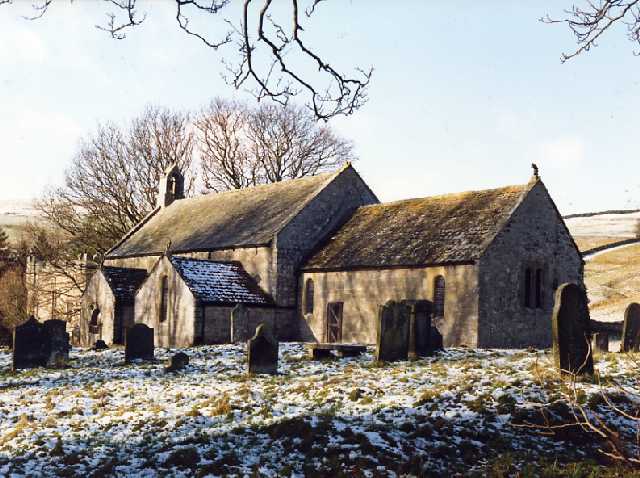
St Michael and All Angels Church, Alnham. Photo by Northumberland County Council, 1990.
Church of St Michael, Alnham. Grade I. Parish church. Saxon foundations. Largely late 12th to early 13th century. Restored 1870 by F R Wilson and again in 1953. Stone slate roofs. West end has a 12th century round headed window with original buttresses. All other windows 1870. Saxon quoins at nave north-east and south-east corners.
Interior: old roof timbers reused forming collar-beam trusses, partly ceiled in nave. Four medieval grave covers in chancel floor. (1)
Church of St Michael and All Angels. Little is known of its history before the Reformation. It was probably first built and maintained by the lord of the manor. In the 12th century it was given to the monks of Alnwick Abbey by William de Vescy. The monks probably built the church in its present form; the Transitional chancel arch dates to this time. Outside, on the north nave wall are the remains of an arcade indicating there was once a north aisle.
The sanctuary was refurnished in 1938. The chancel has four medieval tomb covers in the floor. The font bears the date 1664. (2)
The quoins at the east end of the nave are Saxon. Most of the rest of the church is of the late 12th-early 13th century. It has nave and chancel, south porch, and north and south transepts. The west end has one partly original 12th century round-headed window; the shafts and capitals around it are replacements but the arch and the bases of the shafts are original. South porch and doorway 16th or early 17th century. The porch is tunnel vaulted and both inner and outer doorways are round-headed. North side of nave has three blocked 13th century arches from the former north aisle embedded in it. The chancel arch is round with two chamfers rising from semi-circular responds with simply moulded capitals. Transepts have pointed 13th century arches. Old roof timbers were reused in restoration. 14th century tomb recess in chancel south wall. Small octagonal font, dated 1664. Monument of 1611 to George Alder set into floor of nave; it has wild lettering and unusual spelling. Several 17th and 18th century gravestones in south transept. Good late 19th century glass in east window. The 1870 restoration was by F R Wilson of Alnwick. (3)
Church contains a war memorial as a wall-mounted stone tablet inscribed "SACRED TO THE MEMORY OF/ THE MEN FROM THIS PARISH/ WHO LAID DOWN THEIR LIVES/ IN THE GREAT WAR 1914-1918/ (NAMES)/ "PRO PATRIA". (4)
The earliest documentary reference to the church is a charter of 1184, in which William de Vesci grants Alnham and its tithes to Alnwick Abbey. The church was in great disrepair by the mid 19th century and was restored in 1870 by Alnwick architect F R Wilson, who published before and after plans and drawings of the building. Ryder's report provides a detailed description of the exterior and interior fabric and analysis of structural history. He considers the account by Honeyman in the County History is more definitive than the building's fabric allows:
1) There is too little evidence to claim the survival of Anglo-Saxon fabric;
2) The 1184 century charter fits the date of the first building, of which substantial parts survive;
3) The church was probably wrecked in the Border Wars at the end of the 13th century, after which it was remodelled with new arcades, and extended chancel;
4) An unrecorded catastrophe appears to have occurred and both aisles were lost, followed by a piecemeal patching-up, possibly over a considerable time from the late medieval period into the early post-medieval era, with the chancel rebuilt and transepts replacing the former aisles;
5) The remaining structural history is recorded in written records from 1664 onwards. (5)
Interior: old roof timbers reused forming collar-beam trusses, partly ceiled in nave. Four medieval grave covers in chancel floor. (1)
Church of St Michael and All Angels. Little is known of its history before the Reformation. It was probably first built and maintained by the lord of the manor. In the 12th century it was given to the monks of Alnwick Abbey by William de Vescy. The monks probably built the church in its present form; the Transitional chancel arch dates to this time. Outside, on the north nave wall are the remains of an arcade indicating there was once a north aisle.
The sanctuary was refurnished in 1938. The chancel has four medieval tomb covers in the floor. The font bears the date 1664. (2)
The quoins at the east end of the nave are Saxon. Most of the rest of the church is of the late 12th-early 13th century. It has nave and chancel, south porch, and north and south transepts. The west end has one partly original 12th century round-headed window; the shafts and capitals around it are replacements but the arch and the bases of the shafts are original. South porch and doorway 16th or early 17th century. The porch is tunnel vaulted and both inner and outer doorways are round-headed. North side of nave has three blocked 13th century arches from the former north aisle embedded in it. The chancel arch is round with two chamfers rising from semi-circular responds with simply moulded capitals. Transepts have pointed 13th century arches. Old roof timbers were reused in restoration. 14th century tomb recess in chancel south wall. Small octagonal font, dated 1664. Monument of 1611 to George Alder set into floor of nave; it has wild lettering and unusual spelling. Several 17th and 18th century gravestones in south transept. Good late 19th century glass in east window. The 1870 restoration was by F R Wilson of Alnwick. (3)
Church contains a war memorial as a wall-mounted stone tablet inscribed "SACRED TO THE MEMORY OF/ THE MEN FROM THIS PARISH/ WHO LAID DOWN THEIR LIVES/ IN THE GREAT WAR 1914-1918/ (NAMES)/ "PRO PATRIA". (4)
The earliest documentary reference to the church is a charter of 1184, in which William de Vesci grants Alnham and its tithes to Alnwick Abbey. The church was in great disrepair by the mid 19th century and was restored in 1870 by Alnwick architect F R Wilson, who published before and after plans and drawings of the building. Ryder's report provides a detailed description of the exterior and interior fabric and analysis of structural history. He considers the account by Honeyman in the County History is more definitive than the building's fabric allows:
1) There is too little evidence to claim the survival of Anglo-Saxon fabric;
2) The 1184 century charter fits the date of the first building, of which substantial parts survive;
3) The church was probably wrecked in the Border Wars at the end of the 13th century, after which it was remodelled with new arcades, and extended chancel;
4) An unrecorded catastrophe appears to have occurred and both aisles were lost, followed by a piecemeal patching-up, possibly over a considerable time from the late medieval period into the early post-medieval era, with the chancel rebuilt and transepts replacing the former aisles;
5) The remaining structural history is recorded in written records from 1664 onwards. (5)
N1381
Early Medieval (410 to 1066)
Post Medieval (1540 to 1901)
Early 20th Century (1901 to 1932)
Mid 20th Century (1933 to 1966)
Medieval (1066 to 1540)
Post Medieval (1540 to 1901)
Early 20th Century (1901 to 1932)
Mid 20th Century (1933 to 1966)
Medieval (1066 to 1540)
ANALYTICAL BUILDINGS RECORD (LEVEL 3), Church of St Michael the Archangel ; P Ryder
HISTORIC AREA ASSESSMENT, Alnham Village Atlas ; The Archaeological Practice Ltd
HISTORIC AREA ASSESSMENT, Alnham Village Atlas ; The Archaeological Practice Ltd
Disclaimer -
Please note that this information has been compiled from a number of different sources. Durham County Council and Northumberland County Council can accept no responsibility for any inaccuracy contained therein. If you wish to use/copy any of the images, please ensure that you read the Copyright information provided.