Derwentcote Forge AKA Derwentcote steel furnace, Hamsterley Mill, Hamsterley (Hamsterley, Derwentside)
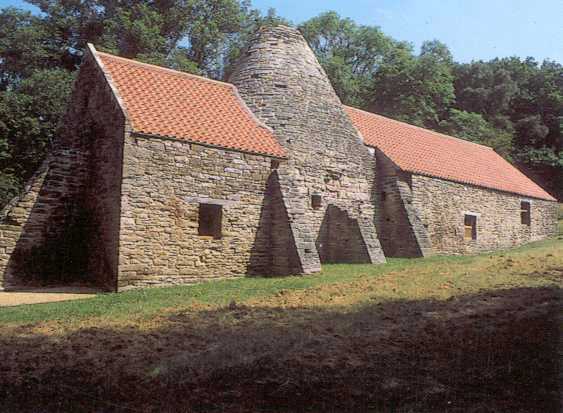
Derwentcote Steel Furnace. c. 1999
Next to the furnace is a forge built in 1718-19 that turned steel from the furnace into finished products. Also, nearby is a coal mine that produced fuel for the furnace.
The furnace, forge and mine workings are very important surviving remains from the Industrial Revolution. Only one other site in the country (and it is much later in date than Derwentcotes) contains such well preserved remains of this early steel-making process. Because of this, the remains are protected by law as a Scheduled Monument.
The monument includes the remains of an iron finery forge and water related earthworks situated on the flood plain of the River Derwent. The forge was constructed in 1718-19 and remained in use until the 1850s when at this date it began to forge steel and later changed to crucible steel production until its closure in 1891. Maps dating to the 19th century show that the forge consisted of two building complexes. The remains of these buildings are visible as building platforms, the footings of stone and brick walls, mounds of tumbled rubble and series of earthworks and hollows. The forge complex was powered by water, and several of the water related earthworks are visible on the flood plain of the River Derwent. These include the sluice, mill pond, headrace, dam and the tailrace. A wall 2 metres high which is visible on the outer face of the mill pond dam is thought to be the remains of the wheel pit.
Fieldwork at Derwentcote Cementation Furnace 1989; David Cranstone
Time Team Evaluation at Derwentcote Forge 2010; Wessex Archaeology DOI:10.5284/1038648
Time Team Geophysical survey at Derwentcote Forge, 2010; GSB Prospection Ltd
Land of Oak and Iron Project Historic Environment Audit 2014; North of England Civic Trust
Field Survey at Derwentcote AKA RCHME: Derwentcote Survey, County Durham 1990; Royal Commission on the Historical Monuments of England DOI:1057094
RCHME: Derwentcote 1991 Survey; Royal Commission on the Historical Monuments of England
Disclaimer -
Please note that this information has been compiled from a number of different sources. Durham County Council and Northumberland County Council can accept no responsibility for any inaccuracy contained therein. If you wish to use/copy any of the images, please ensure that you read the Copyright information provided.