Middle Hurth multi-period site, Middle Hurth Edge, Forest-in-Teesdale (Forest-in-Teesdale)
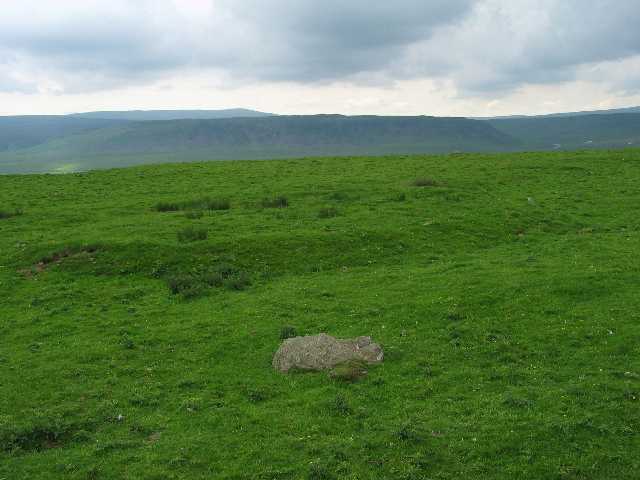
Middle Hurth (County Durham)
Site of a slight long mound of presumed Neolithic date at Middle Hurst. The mound is circa 55 metres long and 8 metres wide, surviving to a height of about 0.50 metres. The eastern half of the mound is overlain by a circular enclosure circa 15 metres in (internal) diameter, with slight traces of a ditch visible on its southern side. Excavations were undertaken in 1978. The spine of the mound was marked by an irregular double row of flat slabs of stone. Numerous flints were recovered from this area, the assemblage mainly comprising small waste flakes, but worked items and a possible perforated macehead were also present. The enclosure bank varied considerably in its make-up. On the south side, it comprised material derived from the ditch and was surmounted by limestone slabs. On the northern side, one section revealed a double row of kerbstones, while on the western side were 3 large limestone slabs leaning against the side of the bank. It was suggested by the excavators that these might originally have stood on top of the bank. A feature described as a "slighted cairn" was found within the enclosure, towards its eastern side. Excavation revealed dark soil, fragments of calcined bones and a small quantity of charcoal. Several flints and a whetstone were also found within the enclosure. Note that the excavators appear to have viewed the enclosure as being placed at the end of the mound, whereas Ordnance Survey field investigation showed clearly that the enclosure overlies the mound. (11)
Medieval (1066 to 1540)
Later Prehistoric (4000BC to 43AD)
Neolithic (4000BC to 2200BC)
Early Neolithic (4000BC to 3300BC)
Early Bronze Age (2600BC to 1600BC)
Iron Age (800BC to 43AD)
Early Iron Age (800BC to 300BC)
Early Mesolithic (10000BC to 7000BC)
Late Mesolithic (7000BC to 4000BC)
21st Century (2001 to 2100)
Uncertain
Disclaimer -
Please note that this information has been compiled from a number of different sources. Durham County Council and Northumberland County Council can accept no responsibility for any inaccuracy contained therein. If you wish to use/copy any of the images, please ensure that you read the Copyright information provided.