Derwentcote Steel Furnace aka The Cone, Forge Lane, Consett
.jpg "Derwent Cote Steel Furnace (The Cone) 2007")
Derwent Cote Steel Furnace (The Cone) 2007
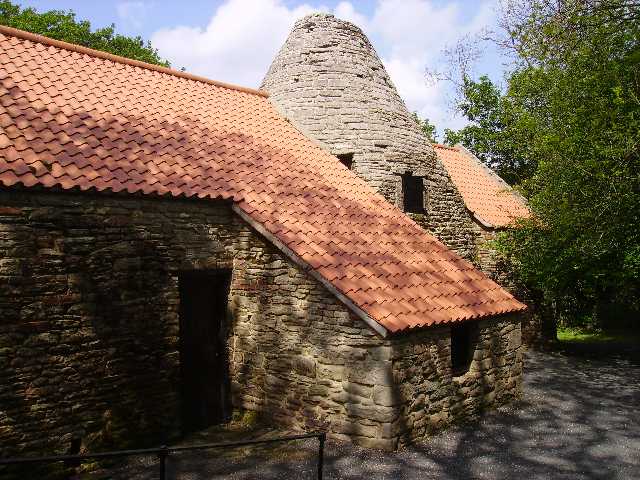
Derwent Cote Steel Furnace (The Cone) 2007
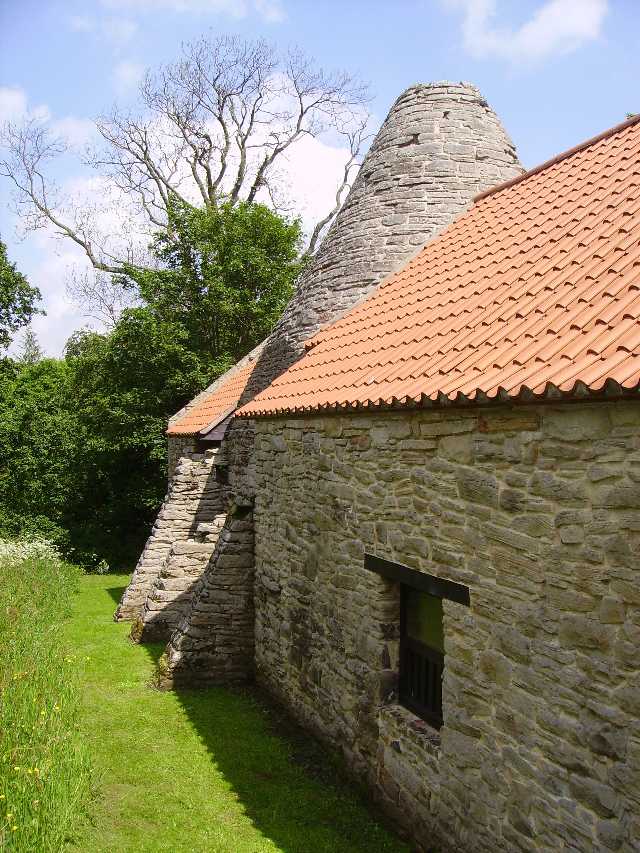
Derwent Cote Steel Furnace (The Cone) 2007
The remains of a steel furnace complex situated on the south side of the River Derwent above its confluence with the River Tyne. The furnace is a sandstone rubble built structure, buttressed on all sides with a central chimney, containing two flue openings on the ground floor. It is adjoined by buildings to the north, south, and south east which have been interpreted as stores. Part excavation at the steel furnace in 1987 and 1988 revealed that it was constructed slightly earlier than the adjoining stores although they were all part of an original plan. Documentary evidence has established that the furnace was constructed around the year 1733. A cornmill and forge were already constructed here about 1717-19. The furnace remained in use until 1875. In its latter years there was a shift to crucible steel production. Excavations also revealed deposits of iron and steel slag within the southern building suggesting that it may have been used for forging or smithing. In the northern part of this building the base of a possible charcoal grinding mill was also uncovered. The part excavations have also identified the presence of timber framed buildings which have been interpreted as sand stores, along with a series of metalled trackways. The foundations of a rectangular building situated 29 metres to the south of the furnace are thought to represent the remains of an associated office. Immediately to the north and east of the furnace an arc of flat topped tips are visible as a series of scarps up to 4 metres high. As well as being the earliest cementation steel furnace in the British Isles, Derwentcote is also the only intact and complete example. The site is in the care of English Heritage.
D36395
Listed Building
• National Heritage List for England Entry Number: 1240411
Scheduled Monument
• National Heritage List for England Entry Number: 1015522
• National Heritage List for England Entry Number: 1240411
Scheduled Monument
• National Heritage List for England Entry Number: 1015522
Time Team Evaluation at Derwentcote Forge 2010; Wessex Archaeology DOI:10.5284/1038648
Time Team Geophysical survey at Derwentcote Forge, 2010; GSB Prospection Ltd
RCHME: Durham SAMs Project 1991; Royal Commission on the Historical Monuments of England
Field Survey at Derwentcote AKA RCHME: Derwentcote Survey, County Durham 1990; Royal Commission on the Historical Monuments of England DOI:1057094
RCHME: Derwentcote 1991 Survey; Royal Commission on the Historical Monuments of England
Time Team Geophysical survey at Derwentcote Forge, 2010; GSB Prospection Ltd
RCHME: Durham SAMs Project 1991; Royal Commission on the Historical Monuments of England
Field Survey at Derwentcote AKA RCHME: Derwentcote Survey, County Durham 1990; Royal Commission on the Historical Monuments of England DOI:1057094
RCHME: Derwentcote 1991 Survey; Royal Commission on the Historical Monuments of England
Disclaimer -
Please note that this information has been compiled from a number of different sources. Durham County Council and Northumberland County Council can accept no responsibility for any inaccuracy contained therein. If you wish to use/copy any of the images, please ensure that you read the Copyright information provided.