Hardwick Park, Sedgefield (Hardwick Park, Sedgefield; Sedgefield)
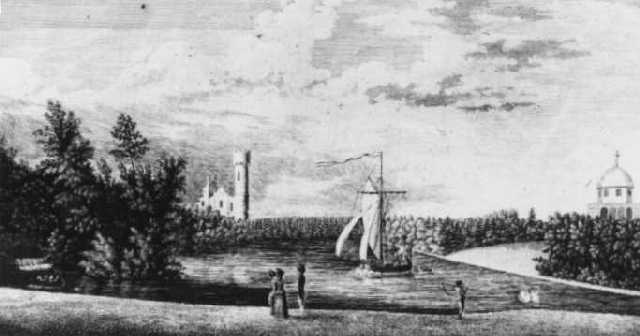
Engraving of Hardwick Park c.1787 by John Bailey

Hardwick Park. c.1856.

The former Lake bed looking towards Hardwick Hall. October 2001

The former Lake bed looking towards the dam. 2001

Sedgefield, Hardwick Park © DCC 2007
Buildings arranged around the lake represented both gothic and classical forms of architecture and were in the order to be visited on a walk around the lake as follows. The Gothic Seat, The Bath-house, The Bono-Retiro and lake cascade, The Temple of Minerva, The Serpentine Bridge, The Statue of Neptune, The Gothic Ruin and finally the Banqueting House.
Over the following 200 years, the Garden and attached 19th century Parkland has been in a steady decline. By 1900 the lake had been drained and the last half of the 20th century saw the collapse and in some cases demolition of several of the fine buildings. Despite this, the structure of the Garden has remained intact and unaltered by later fashions in landscape design. Hardwick today is something of a sleeping beauty and a national treasure, as the only known garden almost exclusively designed by James Paine, and as an unaltered example of 18th century fashion and practice.
Restoration of the Park was begun in 2001 by Durham County Council with support from the Heritage Lottery Fund.
• National Heritage List for England Entry Number: 1000730
Geophysical Survey, Hardwick Park Phase II, 2003; Archaeological Services University of Durham
Evaluation, Hardwick Park restoration Project, Phase III, 2003; Archaeological Services, University of Durham
Evaluation at Sedgefield Cricket Club 2012; Wardell Armstrong Archaeology Ltd DOI:10.5284/1018395
Disclaimer -
Please note that this information has been compiled from a number of different sources. Durham County Council and Northumberland County Council can accept no responsibility for any inaccuracy contained therein. If you wish to use/copy any of the images, please ensure that you read the Copyright information provided.