Church of St Gregory the Great (Kirknewton)
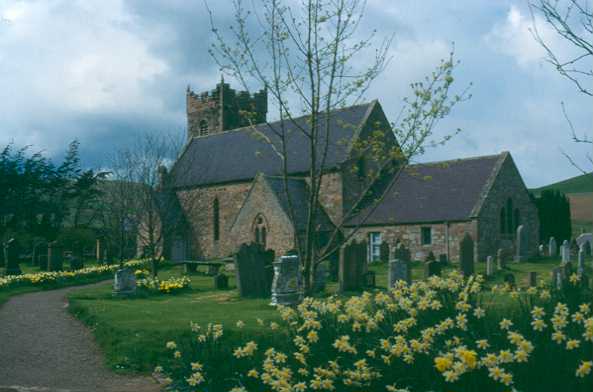
Church of St Gregory the Great, Kirknewton. Photo by Northumberland County Council.
The parish church of Kirknewton was built in the 13th century, but it was greatly altered in the 19th century. In the chancel an unusual carving of the Adoration of the Magi, dating to the 12th century, can be seen. (1-2)
13th or 14th century church, altered in 1860 and late 19th century. Built of roughly-dressed stone with ashlar quoins and dressings, Welsh slate roof; tower built of whinstone. An attractive church from the outside, especially when seen from the east with the progression of chancel and nave roofs and the asymmetrically-placed tower.
Apart from the tower, which is clearly 19th century, there is little indication from outside of the variety of ages. On close examination it is evident that the chancel and the south transept are in older masonry, but the stonework of the nave, which was re-done by John Dobson in 1860, is extremely sympathetic. Most of the openings, including the three-light stepped east window, are simple 19th century lancets, but the chancel south wall has a square-headed priest's door and a small square window, both probably of the 16th century. Finally, on the outside, there are two medieval gravestones built into the tower walls.
Inside, the church is a different story. The nave admittedly is entirely Dobson's, but the transept and the chancel are extraordinary. They both have the most primitive tunnel vaults rising, not very far, but from just above ground level. The effect, espcially in the chancel, is like being in a cave; and the chancel arch, narrow and strangely stunted is like the entrance to that cave.
The date of these vaults is rather problematical. They are normally assigned, on the strength of the chancel arch, to the 13th or early 14th century, but the pirest's door and south window might suggest a 16th century date. They could be either, but it barely matters since their barbaric qualities match so perfectly our vision of what the borders were like. In the transept is an incised monumental slab of 1458 to Andrew Burnell and his wife; it is touchingly elegant in this primitive setting; the faces and hands are indented for brass insets.
There are two fonts, one dated 1663 with ornamented shaft and bowl, and the other an 18th century marble baluster font. In the chancel is a lively gravestone of 1732 to the Rev John Werge.
The east window is in light-coloured glass by Dunston J Powell. The two colourful south windows are by the Atkinson Brothers, a Newcastle firm. (3)
Church includes a series of war memorials including:
* a wall-mounted brass plaque inscribed "IN MEMORY OF/ CHARLES WILLIAM DIXON JOHNSON/ 4TH BATT. W. YORKS/ SECOND SON OF/ CUTHBERT GREENWOOD DIXON JOHNSON/ OF AYKLEY HEADS, DURHAM,/ MISSING AT POLCAPELL IN FLANDERS/ 9TH OCTOBER 1917/ AGED 42./ IF LOVE COULD SAVE + THOU HADST NOT DIED".
* a stained glass window in the north wall of the nave inscribed "IN MEMORY OF/ LIEUTENANT-COMMANDER D.R.B. COSH D.S.C., R.C.N.V.R./ COMMANDING OFFICER 881 NAVAL AIR SQUADRON/ NOVEMBER 1943 JUNE 1944".
* a wall-mounted brass plaque inscribed "IN LOVING MEMORY OF MY HUSBAND/ MATTHEW TEWART CULLEY/ OF COUPLAND CASTLE/ BORN 1832 DIED 1889/ AND OF OUR SON/ GEOFFRY MATTHEW GEORGE,/ CAPTAIN, ROYAL WEST KENT REGIMENT/ BORN 1883 KILLED IN ACTION IN FRANCE, SEPTEMBER 15, 1916/ REQUIESCANT IN PACE".
* a stained glass window "THIS WINDOW IS ERECTED BY OFFICERS NCOS AIRMEN/ AND AIRWOMEN OF R.A.F. MILFIELD TO KEEP ALIVE/ THE MEMORY OF THE MEN WHO DIED FOR THEIR/ COUNTRY WHILE FLYING FROM/ R.A.F. MILFIELD R.A.F STATION". (4)(5)(6)(7)
Detailed description and structural development. Additional reference. (8)
13th or 14th century church, altered in 1860 and late 19th century. Built of roughly-dressed stone with ashlar quoins and dressings, Welsh slate roof; tower built of whinstone. An attractive church from the outside, especially when seen from the east with the progression of chancel and nave roofs and the asymmetrically-placed tower.
Apart from the tower, which is clearly 19th century, there is little indication from outside of the variety of ages. On close examination it is evident that the chancel and the south transept are in older masonry, but the stonework of the nave, which was re-done by John Dobson in 1860, is extremely sympathetic. Most of the openings, including the three-light stepped east window, are simple 19th century lancets, but the chancel south wall has a square-headed priest's door and a small square window, both probably of the 16th century. Finally, on the outside, there are two medieval gravestones built into the tower walls.
Inside, the church is a different story. The nave admittedly is entirely Dobson's, but the transept and the chancel are extraordinary. They both have the most primitive tunnel vaults rising, not very far, but from just above ground level. The effect, espcially in the chancel, is like being in a cave; and the chancel arch, narrow and strangely stunted is like the entrance to that cave.
The date of these vaults is rather problematical. They are normally assigned, on the strength of the chancel arch, to the 13th or early 14th century, but the pirest's door and south window might suggest a 16th century date. They could be either, but it barely matters since their barbaric qualities match so perfectly our vision of what the borders were like. In the transept is an incised monumental slab of 1458 to Andrew Burnell and his wife; it is touchingly elegant in this primitive setting; the faces and hands are indented for brass insets.
There are two fonts, one dated 1663 with ornamented shaft and bowl, and the other an 18th century marble baluster font. In the chancel is a lively gravestone of 1732 to the Rev John Werge.
The east window is in light-coloured glass by Dunston J Powell. The two colourful south windows are by the Atkinson Brothers, a Newcastle firm. (3)
Church includes a series of war memorials including:
* a wall-mounted brass plaque inscribed "IN MEMORY OF/ CHARLES WILLIAM DIXON JOHNSON/ 4TH BATT. W. YORKS/ SECOND SON OF/ CUTHBERT GREENWOOD DIXON JOHNSON/ OF AYKLEY HEADS, DURHAM,/ MISSING AT POLCAPELL IN FLANDERS/ 9TH OCTOBER 1917/ AGED 42./ IF LOVE COULD SAVE + THOU HADST NOT DIED".
* a stained glass window in the north wall of the nave inscribed "IN MEMORY OF/ LIEUTENANT-COMMANDER D.R.B. COSH D.S.C., R.C.N.V.R./ COMMANDING OFFICER 881 NAVAL AIR SQUADRON/ NOVEMBER 1943 JUNE 1944".
* a wall-mounted brass plaque inscribed "IN LOVING MEMORY OF MY HUSBAND/ MATTHEW TEWART CULLEY/ OF COUPLAND CASTLE/ BORN 1832 DIED 1889/ AND OF OUR SON/ GEOFFRY MATTHEW GEORGE,/ CAPTAIN, ROYAL WEST KENT REGIMENT/ BORN 1883 KILLED IN ACTION IN FRANCE, SEPTEMBER 15, 1916/ REQUIESCANT IN PACE".
* a stained glass window "THIS WINDOW IS ERECTED BY OFFICERS NCOS AIRMEN/ AND AIRWOMEN OF R.A.F. MILFIELD TO KEEP ALIVE/ THE MEMORY OF THE MEN WHO DIED FOR THEIR/ COUNTRY WHILE FLYING FROM/ R.A.F. MILFIELD R.A.F STATION". (4)(5)(6)(7)
Detailed description and structural development. Additional reference. (8)
N2050
Post Medieval (1540 to 1901)
Victorian (1837 to 1901)
Early 20th Century (1901 to 1932)
Mid 20th Century (1933 to 1966)
Medieval (1066 to 1540)
Victorian (1837 to 1901)
Early 20th Century (1901 to 1932)
Mid 20th Century (1933 to 1966)
Medieval (1066 to 1540)
HISTORIC AREA ASSESSMENT, Kirknewton Village Atlas (HISTORIC BERWICK VILLAGE ATLAS) ; The Archaeological Practice Ltd
DESCRIPTIVE BUILDINGS RECORD (LEVEL 2), St Gregory the Great ; P Ryder
MANAGEMENT SURVEY, National Park Building at Risk Survey ; Sarah Dyer Heritage
DESCRIPTIVE BUILDINGS RECORD (LEVEL 2), St Gregory the Great ; P Ryder
MANAGEMENT SURVEY, National Park Building at Risk Survey ; Sarah Dyer Heritage
Disclaimer -
Please note that this information has been compiled from a number of different sources. Durham County Council and Northumberland County Council can accept no responsibility for any inaccuracy contained therein. If you wish to use/copy any of the images, please ensure that you read the Copyright information provided.