Prehistoric rock shelter cemetery and Mesolithic flints at Goatscrag (Ford)
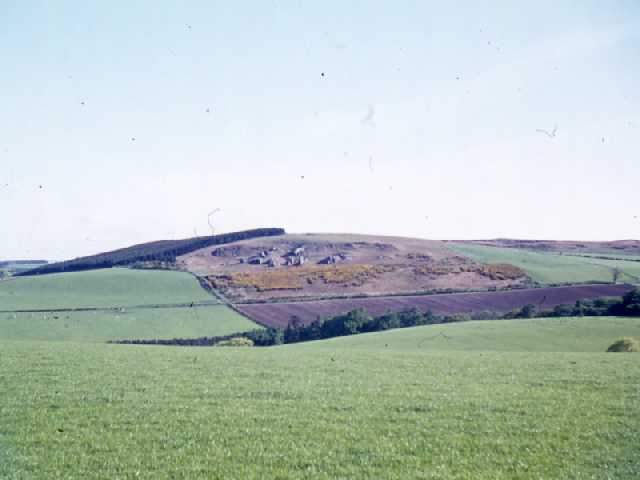
View of Goatscrag from Ford Moss. Photo by Harry Rowland.
(NT 977 370) An Early Bronze Age rock shelter cemetery (site 'A' see plan) was discovered at Goatscrag during excavations in 1967-8 to find evidence of occupation under the crag. The cemetery consisted of four cremation burials, two in inverted Enlarged Food Vessel urns, amidst abundant pits and 'post holes'. In the topsoil above the cemetery several pieces of flint were found including some tools. Excavations at a second site (site 'B' see plan) further to the west along the crag revealed four pits each containing quantities of charcoal in their lower fill. Twenty-one small pieces of flint were found scattered in the topsoil above the site. (1)
Mesolithic flints found at Goatscrag, Wooler. Finds held by C Burgess. (2)
One microlith and two scrapers found at Goats Crag. (3)
Scheduled. (4)
A group of zoomorphic rock carvings have been observed on the rock face at Goatscrag. Their date is unknown, but it is thought that they are probably prehistoric or Romano-British. (5a)
Goatscrag is a lengthy series of crags running roughly east-west, unbroken by intervening rough, steep, bracken-covered, slopes. The tall crags present a south-facing mixture of sheer, overhanging and sloping blocky appearance. Lesser crags and now-detached blocks punctuate the slopes below the main series. The crags are a mixture of greys, dull reds and black colours dependent on the composition of stone at each location.
Panel - Goatscrag Rock Shelter (NT 97712 37019) (ERA 11), In 1984 four 'animal' motifs were discovered are carved into the rock face, 'animal' motifs are very rare in British rock art. The panel is situated immediately above the most westerly of two rock shelters which were subject to partial excavation in the later 1960s. The panel faces west and is a smooth, almost vertical surface 1.5m wide and 2m high. The carvings are undated and could be prehistoric, Roman or early medieval.
Scheduled. For the designation record of this site please see The National Heritage List for England. (5b-c)(5)
Panel :Goatscrag b ' (NT 97712 37019) A second panel (ERA 10) is situated on the top of the crag at about 160m OD immediately above the rock shelter containing the animal carvings. The panel measures about 2.35 m by 0.83m and there are at least two prehistoric cup marks present, one about 8cm to 10cm in diameter and the other slightly smaller.
Scheduled. For the designation record of this site please see The National Heritage List for England. (4d) (4)
Panel : Goatscrag a (NT 97664 37040) ' A third panel (ERA 8) is positioned precariously close to the edge of a big drop. Two cups are linked by curved grooves, giving the appearance of horseshoes. A total of 10 `horse shoes' and two other cups are present. The panel is 11.2m long, 8 m wide and 0.8 m high oriented west-east. (4)
The information for the rock art was recorded by the NADRAP project. Assessments were made 2005-2008 building on the data in the Beckensall Archive (4)
Additional references. (5)
1971 Excavation of small rock shelter in sandstone crag line. No depth of deposit. 573ft OD. Eight retouched flints. PaMeLA id 13099, artefact id 21358 to 21362. (6)
Mesolithic flints found at Goatscrag, Wooler. Finds held by C Burgess. (2)
One microlith and two scrapers found at Goats Crag. (3)
Scheduled. (4)
A group of zoomorphic rock carvings have been observed on the rock face at Goatscrag. Their date is unknown, but it is thought that they are probably prehistoric or Romano-British. (5a)
Goatscrag is a lengthy series of crags running roughly east-west, unbroken by intervening rough, steep, bracken-covered, slopes. The tall crags present a south-facing mixture of sheer, overhanging and sloping blocky appearance. Lesser crags and now-detached blocks punctuate the slopes below the main series. The crags are a mixture of greys, dull reds and black colours dependent on the composition of stone at each location.
Panel - Goatscrag Rock Shelter (NT 97712 37019) (ERA 11), In 1984 four 'animal' motifs were discovered are carved into the rock face, 'animal' motifs are very rare in British rock art. The panel is situated immediately above the most westerly of two rock shelters which were subject to partial excavation in the later 1960s. The panel faces west and is a smooth, almost vertical surface 1.5m wide and 2m high. The carvings are undated and could be prehistoric, Roman or early medieval.
Scheduled. For the designation record of this site please see The National Heritage List for England. (5b-c)(5)
Panel :Goatscrag b ' (NT 97712 37019) A second panel (ERA 10) is situated on the top of the crag at about 160m OD immediately above the rock shelter containing the animal carvings. The panel measures about 2.35 m by 0.83m and there are at least two prehistoric cup marks present, one about 8cm to 10cm in diameter and the other slightly smaller.
Scheduled. For the designation record of this site please see The National Heritage List for England. (4d) (4)
Panel : Goatscrag a (NT 97664 37040) ' A third panel (ERA 8) is positioned precariously close to the edge of a big drop. Two cups are linked by curved grooves, giving the appearance of horseshoes. A total of 10 `horse shoes' and two other cups are present. The panel is 11.2m long, 8 m wide and 0.8 m high oriented west-east. (4)
The information for the rock art was recorded by the NADRAP project. Assessments were made 2005-2008 building on the data in the Beckensall Archive (4)
Additional references. (5)
1971 Excavation of small rock shelter in sandstone crag line. No depth of deposit. 573ft OD. Eight retouched flints. PaMeLA id 13099, artefact id 21358 to 21362. (6)
N1962
EXCAVATION, A Bronze Age rock shelter in north Northumberland and other rock shelters and craglines in the region 1968; Newcastle University Excavation Committee
Disclaimer -
Please note that this information has been compiled from a number of different sources. Durham County Council and Northumberland County Council can accept no responsibility for any inaccuracy contained therein. If you wish to use/copy any of the images, please ensure that you read the Copyright information provided.