Dere Street Roman road (Alwinton; Birtley; Corsenside; Rochester and Byrness; Sandhoe; Broomhaugh and Riding; Wall; Whittington; Otterburn; Chollerton; Corbridge; Shotley Low Quarter; Broomley and Stocksfield)
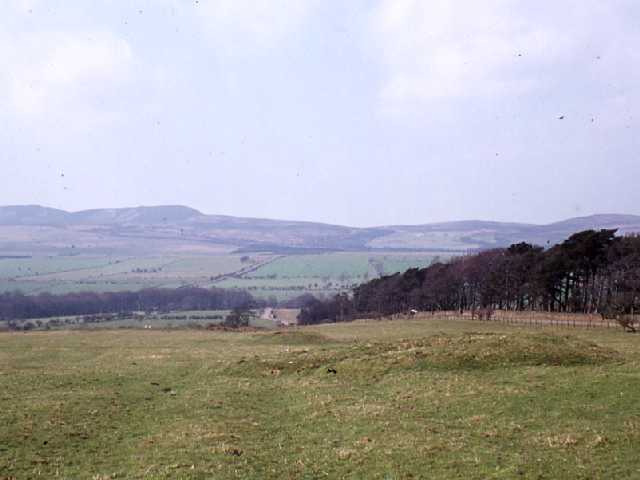
Route of Dere Street in mid Northumberland. Photo by Harry Rowland.
In 2002 evaluation trench in the southern portion of the Otterburn Training Area between Featherwood and High Rochester remains of the road Dere Street were found. The road was 7.8m wide as densely packed sandstone cobbles, with kerbs on both sides. A western kerb was distinct as larger stones than the rest of the surface, though less well-defined on the east. The uppermost surfaces of the road were recorded as pebbles and loose sand over the cobbles. Silty sand lay on either side of the road and it is probable that some of this has come from the agger mound portions of the road. The excavated section compares with other portions of the road excavated. (1)
Dere Street remained in use throughout the medieval period and right up to the end of the 18th century as a major cross-border thoroughfare. Dere Street finally seems to have fallen out of significant use in the early 19th century with the end of cattle droving. (2)
In the Otterburn Training Area a military road was built through the ranges in the mid 1940s and this takes the line of Dere Street for much of its course. Dere Street was described by Richmond in 1948 as a great agger of local clay 3 feet high and 28 feet wide surfaced with a skin of broken shale; it seems possible this may be the stretch next to Middle Golden Pot. The metalling of Dere Street was exposed in the 1970s when ditches alongside the modern military road were cut, between Redesdale Camp and Featherwood. Excavations of Dere Street have also been carried out in the 1990s near Bremenium (High Rochester) by Newcastle University, revealing it to be about 5.4m wide with a kerb of regular stones along its eastern edge.
Trial trenching and geophysical survey in 1995 confirmed the line of Dere Street at two locations not previously demonstrated, respectively at NY 82503 99412 and between NT810 066 and NT 808 069. (3)
Known as Dere Street since Saxon times, and as Watling Street for much of the 18th and part of the 19th century. It runs northwards from Corbridge and passes through Hadrian's Wall at Portgate. Two kilometres north of the Wall the road divides, with Dere Street continuing north-westwards and the Devil's Causeway heading north-eastwards. Dere Street crosses the River Rede at Habitancum (Risingham) and continues to Bremenium (Rochester) and the Anglo-Scottish border at Chew Green.
Dere Street was built during the first Roman occupation of the region under Agricola from AD79, but may utilise pre-existing courses in places. The section immediately south of Chew Green is known as Gamelspath. The route was used throughout the medieval and post-medieval period and its demise came in the 19th century with the decline of droving. (4)
A limited watching brief trench excavated at a point 55m north of Shawwell Farm, within Corbridge parish, in the eastern verge of the A68 portion of Dere Street by TWM Archaeology during 2012 revealed that a metalled surface of the road in part survives at 100.13m aOD. The surface is noted as consisted of a mixture of rounded and sub-angular sandstone cobbles and pebbles of small to larger sizes, rising towards the west suggestive of a cambered surface. No evidence was recorded of a kerb, though Modern service trenches had truncated the remains present in this area. (5)
A watching brief-cum-evaluation trial trench was undertaken by Pre-Construct Archaeology between 21 February to 2 March 2011 to the southeast of Farnley Gate just within Broomhaugh and Riding parish. A series of four trenches were excavated in turn along a single alignment crossing the carriageway and verges of the present day A695 road which overlies part of Dere Street between Corbridge and Riding Mill. The narrow evaluation trench revealed the remains of Dere Street to survive beneath the present day road. In the first phase a mid-brown orange silty sand with occasional fine and medium-sized sub-rounded pebbles and cobbles was revealed as the agger mound, being topped with pebbles and cobbles for a road at least 4.0m wide. No roadside trench was revealed for the drainage of the agger mound. A second phase of the road surfaces revealed is thought likely to be Roman in date, with a series of levelling deposit layers the base for further road metalling possibly significantly widening the whole of the road, before undated deposits probably post-Roman in date and Modern surfaces. (6)
Watching brief work carried out for a new pipe trench in October 1991 encountered the line of Dere Street at 111m west of the stone bridge at Ebchester across the River Derwent, with the remains of the road itself being found some 5m of this point at NZ 0995 5545. The road was constructed of a layer of glacial gravel of various sizes overlying random boulders about 0.60m below the ground level of the area. The width of the road was revealed as 6.2m and cambered on either side to provide drainage for surface water, but without side ditch drains. Only one piece of Roman mortaria pottery was recovered. (7)
Watching brief work carried out at the eastern corner of the Petty Knowes Roman Cemetery by AAG Archaeology during 2013 only possibly recorded Dere Street. A line of rocks protruding from the ground; these may be the edge stones of the Roman road, though this is uncertain. The line of stones appears to mark the edge of the shelf or terrace that support the road. It may be that the bulk of the agger has been robbed or eroded away at this point. (8)
Evaluation trial pits excavated at Portgate in 2018, discovered below-ground remains of Dere Street in two locations. They revealed deposits interpreted as the agger of Dere Street. They comprised compact sandstone rubble fragments in a clay matrix, overlying a clay deposit between 0.1m and 0.29m thick. The remains suggest a single phase of construction; however, this could reflect truncation during construction of the modern road, whiah was evident in one of the trial pits where modern asphalt lay directly on sandstone agger material. (9)
Route information and maps. (10)
The truncated remains of Dere Street were observed in two locations during a watching brief at Whittonstall in May 2018 and June and July 2019. It comprised a single course of mixed limestone and sandstones on top of natural clay substrate. No definite dressing material remained, other than small patches of gravel, and no camber or roadside ditch were observed. The road measured 5.4m wide but taking account of truncation was probably wider. (11)
Dere Street. RR 8e Corbridge - High Rochester. (12a-d)
Dere Street leads out of Corbridge as a low agger and the road up Stagshaw Bank approximately marks the course. A fresh alignment more to the north-west is seen on high ground just before Portgate and the Wall crosing, suggesting that the layout of the road preceded that of the Wall.
The new alignment is followed to Bewclay where it turns slightly more north-westerly and, although modified in a series of shorter straights, it follows this general course to High Rochester. The present road follows it for most of the way to Ellishaw Bridge although original agger is visible in parts. (12e-f)
Located on the English Heritage map of Hadrian's Wall 2010. (12g)
General association with HER 7943 (Habitancum Roman Fort), HER 7947 (Roman bridge), HER 8091 (High Rochester Roman Fort), HER 8104 (Bagraw), HER 8277 (Dargues), HER 8278 (Blakehope), HER 9002 (Corbridge Roman Town), HER 9494 (Roman milestone), HER 9498 (Swine Hill 1 (Four Laws)), HER 31645 (Swine Hill 2 (Four Laws)), HER 31433 (Dere Street), HER 34110 (part of Dere Street), HER 34105 (possible Roman road), HER 34111 (Dere Street), HER 34112 (Stanegate), HER 9004 (Farnley 1), HER 9836 (Chapel Of St Philip And St James), HER 34093 (Farnley 2), (12)
Dere Street. RR 8d Roman Road. Binchester - Corbridge.
The road left Binchester (NZ 23 SW 16) in a north-westerly direction across the River Wear to Hunwick but its course is not visible. The road towards Willington follows the course, but just before the village it bears away and a short piece of agger appears in a field on its north side. Here the branch road RR 83 LINEAR 295) diverged north-eastward towards Durham.
A side street called Watling Terrace marks the course for a few yards, after which it runs across country, soon turning from east of north to due north. Approaching Oakenshaw it is marked by a track and hedgerows, and elsewhere there are faint traces of the agger, particularly near West Brandon Farm, where a formerly large agger across a golf course has now been ploughed and visible only as a faint swelling. Beyond Hill House, field walls and a cart track mark the course and the agger is faintly visible. On reaching the edge of Rag Path Wood, the road turns sharply to the north-west and slants down the hillside as a terrace, now a hollow way.
Beyond the valley the road climbed direct through the fields to Heugh Farm and to the hamlet of Quebec, where it joined the present road. East of Willy Hill it shows plainly in the fields east of the present road as a large spread agger, some 1-2 feet high, until it joins the road again as far as Square House. Beyond here, mining has destroyed it and the course is not traceable, except for hedgerows, to the Roman fort at Lanchester (NZ 14 NE 4); it seems likely that the road passed outside the south wall of the fort.
Beyond this there are traces at some points in the fields between Newbiggin and Lanchester. As it approaches and crosses the present road near Low Woodside, it is followed by hedges with traces of agger, this line is very plain up to where the modern road rejoins it at Iveston. The course then runs very straight to Leadgate and Brown Hill, where a slight turn to the north was made. It then continues very straight and down the steep hill into Ebchester fort (NZ 15 NW 6).
Beyond the River Derwent the course is not clear, partly owing to mining. At Morrowfield the present road follows it upon a single alignment to beyond Whittonstall. At Apperley Dene the old road lay to the west, terraced up on the hillside. Its structure was examined here and found to be 22 feet wide with a heavy kerb of sandstone blocks on the eastern, downhill side, although damaged and lacking its surface layer.
Where the present road bends east to pass through Broomley, the agger can be seen in places as a low swelling across the fields until the road rejoins it. At the descent into the Tyne valley at Riding Mill the road passes through a pine wood where the agger is some 40 feet wide and 2 feet high, below the present road. On the north side of the village street the cobbles and kerbs were revealed in digging a gas-main trench.
Beyond Farnley the old road lies a little to the south of the modern road, and can be traced at some points through the fields. Then it turns down the hillside to cross Dilston Haughs by the cemetery to the site of the Roman bridge over the Tyne ( NY 96 SE 40 ) and the fort at Corbridge ( NY 96 SE 20).
The Antonine Iter I follows this road and the distances given are in good agreement with the actual mileage. (12h)
See Linear Archive File for further details. (12i)
The site described by authorities 12h-12i has been mapped for the Durham Magnesian Limestone Durham NMP project. A small section of the road is visible as a cropmark centred at NZ 2076 3147, heading in a north westerly direction from Binchester Roman Fort (NZ 23 SW 16) and measuring approximately 175m. Another section of the road can be seen to the south going into the fort, running along the same axis. This section is visible as an cropmark bank centred at NZ 2105 3127 and measures approximately 182m in length and 4m wide. (12l-m)
Air photographs taken in 2006 show the Dere Street clearly as cropmarks just to the south of the River Tyne and Corbridge Roman town. Both the agger of the road and its bounding ditches are intermittantly visible across 2 fields from NY 9846 6311 to NY 9819 6411. There maybe traces of the agger showing in a third field immediately to the south of the river, centred at NY 9810 6426. A second road appears to join with Dere Stree from the east, this has been recorded separately in record 1462046. (12n-o)
Located on the English Heritage map of Hadrian's Wall 2010. (12g)
NY 88794 86340. At Risingham, geophysicl survey across the flood plain north-west of the fort suggest post-Roman river action has been responsible for the removal of surface remains of the road and the majority of the bridge-works noted by Hodgson in 1824. Possible traces of the road appeared in grid 2 but were inconclusive. (13)
NY 82520 99360 Dere Street passes through this km sq from its SE corner to the centre of its N edge. At the given NGR a good section of the Roman earthwork survives, apparently little disturbed by later activity; N of this point it is overlain by a modern road, to the S it is less clear though still visible in places.
NY 84720 96600 The line of Dere St passes SE-NW through the E half of this km sq. On lidar imagery with lighting from the NE it can be clearly seen as an earthwork running parallel to the W rampart of Bagraw Roman Camp. N of the camp, the line of the road has been used as a field boundary, with post-medieval rigg aligned in different directions to either side of it.
NY 84280 97500 Dere Street runs from the NW corner of this km sq in a SSE direction to the S edge of the km sq; its camber is clearly visible as an earthwork on lidar imagery, especially when lit from the NE.
NY 8570 9465 Dere Street is clearly visible as an earthwork on lidar imagery within this km sq. It is partially overlain by the A68 in the S half of the km sq, but not in the N half where it is partially overlain by earthworks resulting form post-med coal mining. The relationship of Dere Street to the camp and forts at Blakehope appears clear on lidar imagery (see HER 8278).
NY 85080 95950. The line of Dere Street passes NNW-SSE through this km sq, but little sign of it can be seen on lidar imagery due to medieval and later ploughing. A linear earthwork visible on lidar imagery at the NW corner of the km sq, at the given NGR, might be a remnant of it.
NY 86800 92700. The line of Dere Street Roman road passes NNW-SSE through this km sq. It is visible as an earthwork on lidar imagery in places, though in the middle of this stretch it has been flattened by medieval and later ploughing.
NY 86400 93400. The line of Dere Street passes across this km sq from N to S but is almost entirely overlain by the modern A68 and any features adjacent to it that may have existed have been subsumed within heavily ploughed medieval fields (other than Dargues camp, lying mostly on the adjacent km sq to the W). There are hints of possible fortlet or camp ramparts in a couple of places to the E of Dere Street (see HER 36051), but these could be entirely elements of the medieval field system rather than anything Roman.
NY 83600 98440. Visible on lidar imagery.
NY 88848680. Stretch of Dere Street north of the Rede survives as a very clear earthwork on lidar imagery. South of the river it is not visible, presumably due to erosion on the floodplain.
NY 88878705. Section of Dere Street surviving as a visible earthwork on lidar imagery immediately S of Woodhouse, N of which the Roman road is now overlain by the A68.
NY 89848432. Line of Dere Street clearly visible as an earthwork passing N-S through this km sq. In N of this km sq the line of the road seems to formed a boundary between medieval fields, suggesting it may have been used as a trackway between fields. Partially overlain in SE by post-medieval ironstone working. NGR is for a well-preserved stretch in the SE corner of this km sq, where camber of road seems to survive flanked by ditches. (14)
Dere Street remained in use throughout the medieval period and right up to the end of the 18th century as a major cross-border thoroughfare. Dere Street finally seems to have fallen out of significant use in the early 19th century with the end of cattle droving. (2)
In the Otterburn Training Area a military road was built through the ranges in the mid 1940s and this takes the line of Dere Street for much of its course. Dere Street was described by Richmond in 1948 as a great agger of local clay 3 feet high and 28 feet wide surfaced with a skin of broken shale; it seems possible this may be the stretch next to Middle Golden Pot. The metalling of Dere Street was exposed in the 1970s when ditches alongside the modern military road were cut, between Redesdale Camp and Featherwood. Excavations of Dere Street have also been carried out in the 1990s near Bremenium (High Rochester) by Newcastle University, revealing it to be about 5.4m wide with a kerb of regular stones along its eastern edge.
Trial trenching and geophysical survey in 1995 confirmed the line of Dere Street at two locations not previously demonstrated, respectively at NY 82503 99412 and between NT810 066 and NT 808 069. (3)
Known as Dere Street since Saxon times, and as Watling Street for much of the 18th and part of the 19th century. It runs northwards from Corbridge and passes through Hadrian's Wall at Portgate. Two kilometres north of the Wall the road divides, with Dere Street continuing north-westwards and the Devil's Causeway heading north-eastwards. Dere Street crosses the River Rede at Habitancum (Risingham) and continues to Bremenium (Rochester) and the Anglo-Scottish border at Chew Green.
Dere Street was built during the first Roman occupation of the region under Agricola from AD79, but may utilise pre-existing courses in places. The section immediately south of Chew Green is known as Gamelspath. The route was used throughout the medieval and post-medieval period and its demise came in the 19th century with the decline of droving. (4)
A limited watching brief trench excavated at a point 55m north of Shawwell Farm, within Corbridge parish, in the eastern verge of the A68 portion of Dere Street by TWM Archaeology during 2012 revealed that a metalled surface of the road in part survives at 100.13m aOD. The surface is noted as consisted of a mixture of rounded and sub-angular sandstone cobbles and pebbles of small to larger sizes, rising towards the west suggestive of a cambered surface. No evidence was recorded of a kerb, though Modern service trenches had truncated the remains present in this area. (5)
A watching brief-cum-evaluation trial trench was undertaken by Pre-Construct Archaeology between 21 February to 2 March 2011 to the southeast of Farnley Gate just within Broomhaugh and Riding parish. A series of four trenches were excavated in turn along a single alignment crossing the carriageway and verges of the present day A695 road which overlies part of Dere Street between Corbridge and Riding Mill. The narrow evaluation trench revealed the remains of Dere Street to survive beneath the present day road. In the first phase a mid-brown orange silty sand with occasional fine and medium-sized sub-rounded pebbles and cobbles was revealed as the agger mound, being topped with pebbles and cobbles for a road at least 4.0m wide. No roadside trench was revealed for the drainage of the agger mound. A second phase of the road surfaces revealed is thought likely to be Roman in date, with a series of levelling deposit layers the base for further road metalling possibly significantly widening the whole of the road, before undated deposits probably post-Roman in date and Modern surfaces. (6)
Watching brief work carried out for a new pipe trench in October 1991 encountered the line of Dere Street at 111m west of the stone bridge at Ebchester across the River Derwent, with the remains of the road itself being found some 5m of this point at NZ 0995 5545. The road was constructed of a layer of glacial gravel of various sizes overlying random boulders about 0.60m below the ground level of the area. The width of the road was revealed as 6.2m and cambered on either side to provide drainage for surface water, but without side ditch drains. Only one piece of Roman mortaria pottery was recovered. (7)
Watching brief work carried out at the eastern corner of the Petty Knowes Roman Cemetery by AAG Archaeology during 2013 only possibly recorded Dere Street. A line of rocks protruding from the ground; these may be the edge stones of the Roman road, though this is uncertain. The line of stones appears to mark the edge of the shelf or terrace that support the road. It may be that the bulk of the agger has been robbed or eroded away at this point. (8)
Evaluation trial pits excavated at Portgate in 2018, discovered below-ground remains of Dere Street in two locations. They revealed deposits interpreted as the agger of Dere Street. They comprised compact sandstone rubble fragments in a clay matrix, overlying a clay deposit between 0.1m and 0.29m thick. The remains suggest a single phase of construction; however, this could reflect truncation during construction of the modern road, whiah was evident in one of the trial pits where modern asphalt lay directly on sandstone agger material. (9)
Route information and maps. (10)
The truncated remains of Dere Street were observed in two locations during a watching brief at Whittonstall in May 2018 and June and July 2019. It comprised a single course of mixed limestone and sandstones on top of natural clay substrate. No definite dressing material remained, other than small patches of gravel, and no camber or roadside ditch were observed. The road measured 5.4m wide but taking account of truncation was probably wider. (11)
Dere Street. RR 8e Corbridge - High Rochester. (12a-d)
Dere Street leads out of Corbridge as a low agger and the road up Stagshaw Bank approximately marks the course. A fresh alignment more to the north-west is seen on high ground just before Portgate and the Wall crosing, suggesting that the layout of the road preceded that of the Wall.
The new alignment is followed to Bewclay where it turns slightly more north-westerly and, although modified in a series of shorter straights, it follows this general course to High Rochester. The present road follows it for most of the way to Ellishaw Bridge although original agger is visible in parts. (12e-f)
Located on the English Heritage map of Hadrian's Wall 2010. (12g)
General association with HER 7943 (Habitancum Roman Fort), HER 7947 (Roman bridge), HER 8091 (High Rochester Roman Fort), HER 8104 (Bagraw), HER 8277 (Dargues), HER 8278 (Blakehope), HER 9002 (Corbridge Roman Town), HER 9494 (Roman milestone), HER 9498 (Swine Hill 1 (Four Laws)), HER 31645 (Swine Hill 2 (Four Laws)), HER 31433 (Dere Street), HER 34110 (part of Dere Street), HER 34105 (possible Roman road), HER 34111 (Dere Street), HER 34112 (Stanegate), HER 9004 (Farnley 1), HER 9836 (Chapel Of St Philip And St James), HER 34093 (Farnley 2), (12)
Dere Street. RR 8d Roman Road. Binchester - Corbridge.
The road left Binchester (NZ 23 SW 16) in a north-westerly direction across the River Wear to Hunwick but its course is not visible. The road towards Willington follows the course, but just before the village it bears away and a short piece of agger appears in a field on its north side. Here the branch road RR 83 LINEAR 295) diverged north-eastward towards Durham.
A side street called Watling Terrace marks the course for a few yards, after which it runs across country, soon turning from east of north to due north. Approaching Oakenshaw it is marked by a track and hedgerows, and elsewhere there are faint traces of the agger, particularly near West Brandon Farm, where a formerly large agger across a golf course has now been ploughed and visible only as a faint swelling. Beyond Hill House, field walls and a cart track mark the course and the agger is faintly visible. On reaching the edge of Rag Path Wood, the road turns sharply to the north-west and slants down the hillside as a terrace, now a hollow way.
Beyond the valley the road climbed direct through the fields to Heugh Farm and to the hamlet of Quebec, where it joined the present road. East of Willy Hill it shows plainly in the fields east of the present road as a large spread agger, some 1-2 feet high, until it joins the road again as far as Square House. Beyond here, mining has destroyed it and the course is not traceable, except for hedgerows, to the Roman fort at Lanchester (NZ 14 NE 4); it seems likely that the road passed outside the south wall of the fort.
Beyond this there are traces at some points in the fields between Newbiggin and Lanchester. As it approaches and crosses the present road near Low Woodside, it is followed by hedges with traces of agger, this line is very plain up to where the modern road rejoins it at Iveston. The course then runs very straight to Leadgate and Brown Hill, where a slight turn to the north was made. It then continues very straight and down the steep hill into Ebchester fort (NZ 15 NW 6).
Beyond the River Derwent the course is not clear, partly owing to mining. At Morrowfield the present road follows it upon a single alignment to beyond Whittonstall. At Apperley Dene the old road lay to the west, terraced up on the hillside. Its structure was examined here and found to be 22 feet wide with a heavy kerb of sandstone blocks on the eastern, downhill side, although damaged and lacking its surface layer.
Where the present road bends east to pass through Broomley, the agger can be seen in places as a low swelling across the fields until the road rejoins it. At the descent into the Tyne valley at Riding Mill the road passes through a pine wood where the agger is some 40 feet wide and 2 feet high, below the present road. On the north side of the village street the cobbles and kerbs were revealed in digging a gas-main trench.
Beyond Farnley the old road lies a little to the south of the modern road, and can be traced at some points through the fields. Then it turns down the hillside to cross Dilston Haughs by the cemetery to the site of the Roman bridge over the Tyne ( NY 96 SE 40 ) and the fort at Corbridge ( NY 96 SE 20).
The Antonine Iter I follows this road and the distances given are in good agreement with the actual mileage. (12h)
See Linear Archive File for further details. (12i)
The site described by authorities 12h-12i has been mapped for the Durham Magnesian Limestone Durham NMP project. A small section of the road is visible as a cropmark centred at NZ 2076 3147, heading in a north westerly direction from Binchester Roman Fort (NZ 23 SW 16) and measuring approximately 175m. Another section of the road can be seen to the south going into the fort, running along the same axis. This section is visible as an cropmark bank centred at NZ 2105 3127 and measures approximately 182m in length and 4m wide. (12l-m)
Air photographs taken in 2006 show the Dere Street clearly as cropmarks just to the south of the River Tyne and Corbridge Roman town. Both the agger of the road and its bounding ditches are intermittantly visible across 2 fields from NY 9846 6311 to NY 9819 6411. There maybe traces of the agger showing in a third field immediately to the south of the river, centred at NY 9810 6426. A second road appears to join with Dere Stree from the east, this has been recorded separately in record 1462046. (12n-o)
Located on the English Heritage map of Hadrian's Wall 2010. (12g)
NY 88794 86340. At Risingham, geophysicl survey across the flood plain north-west of the fort suggest post-Roman river action has been responsible for the removal of surface remains of the road and the majority of the bridge-works noted by Hodgson in 1824. Possible traces of the road appeared in grid 2 but were inconclusive. (13)
NY 82520 99360 Dere Street passes through this km sq from its SE corner to the centre of its N edge. At the given NGR a good section of the Roman earthwork survives, apparently little disturbed by later activity; N of this point it is overlain by a modern road, to the S it is less clear though still visible in places.
NY 84720 96600 The line of Dere St passes SE-NW through the E half of this km sq. On lidar imagery with lighting from the NE it can be clearly seen as an earthwork running parallel to the W rampart of Bagraw Roman Camp. N of the camp, the line of the road has been used as a field boundary, with post-medieval rigg aligned in different directions to either side of it.
NY 84280 97500 Dere Street runs from the NW corner of this km sq in a SSE direction to the S edge of the km sq; its camber is clearly visible as an earthwork on lidar imagery, especially when lit from the NE.
NY 8570 9465 Dere Street is clearly visible as an earthwork on lidar imagery within this km sq. It is partially overlain by the A68 in the S half of the km sq, but not in the N half where it is partially overlain by earthworks resulting form post-med coal mining. The relationship of Dere Street to the camp and forts at Blakehope appears clear on lidar imagery (see HER 8278).
NY 85080 95950. The line of Dere Street passes NNW-SSE through this km sq, but little sign of it can be seen on lidar imagery due to medieval and later ploughing. A linear earthwork visible on lidar imagery at the NW corner of the km sq, at the given NGR, might be a remnant of it.
NY 86800 92700. The line of Dere Street Roman road passes NNW-SSE through this km sq. It is visible as an earthwork on lidar imagery in places, though in the middle of this stretch it has been flattened by medieval and later ploughing.
NY 86400 93400. The line of Dere Street passes across this km sq from N to S but is almost entirely overlain by the modern A68 and any features adjacent to it that may have existed have been subsumed within heavily ploughed medieval fields (other than Dargues camp, lying mostly on the adjacent km sq to the W). There are hints of possible fortlet or camp ramparts in a couple of places to the E of Dere Street (see HER 36051), but these could be entirely elements of the medieval field system rather than anything Roman.
NY 83600 98440. Visible on lidar imagery.
NY 88848680. Stretch of Dere Street north of the Rede survives as a very clear earthwork on lidar imagery. South of the river it is not visible, presumably due to erosion on the floodplain.
NY 88878705. Section of Dere Street surviving as a visible earthwork on lidar imagery immediately S of Woodhouse, N of which the Roman road is now overlain by the A68.
NY 89848432. Line of Dere Street clearly visible as an earthwork passing N-S through this km sq. In N of this km sq the line of the road seems to formed a boundary between medieval fields, suggesting it may have been used as a trackway between fields. Partially overlain in SE by post-medieval ironstone working. NGR is for a well-preserved stretch in the SE corner of this km sq, where camber of road seems to survive flanked by ditches. (14)
N12392
EXCAVATION, Apperley Dene 1951
EXCAVATION, Corbridge Bypass: The Ustriunum 1974; Society of Antiquaries of Newcastle upon Tyne
WATCHING BRIEF, Dere Street, The Haugh 1993
GEOPHYSICAL SURVEY, Otterburn Training Area 1995; GSB Prospection
TRIAL TRENCH, Otterburn Ranges (Otterburn II Chew Green; Bellshiel Roman Camp; Dere Street) 1995; The Archaeological Practice
TRIAL TRENCH, Riding Mill, Dere Street 1995; TYNE AND WEAR MUSEUMS
TRIAL TRENCH, Otterburn Training Area (Dere Street) 1996; The Archaeological Practice
WATCHING BRIEF, Dere Street, Corbridge 1997; NORTHERN ARCHAEOLOGICAL ASSOCIATES
EXCAVATION, High Rochester 1997; Newcastle University
EVALUATION, Dere Street at Chew Green, Border Ridge (Pennine Way National Trail) 2001; The Archaeological Practice
WATCHING BRIEF, Otterburn Training Area, 2002-2005 2005; Archaeological Services Durham University
EXCAVATION, Otterburn Training Area, 2002-2005 2005; Archaeological Services Durham University
WATCHING BRIEF, Fourlaws Farm Cottage 2007; Alan Williams Archaeology
WATCHING BRIEF, The Scrogs, Dilston 2009; Pre-Construct Archaeology
TRIAL TRENCH, A695 at Farnley Gate, near Riding Mill 2011; Pre-Construct Archaeology
WATCHING BRIEF, Shawwell Farm Water Main 2012; TWM Archaeology
WATCHING BRIEF, Petty Knowes, Rochester 2013; AAG Archaeology
DESK BASED ASSESSMENT, Land at Riding Mill 2015; Archaeological Services Durham University
WATCHING BRIEF, Land at Stagshaw Bank 2017; Archaeological Research Services
EVALUATION, Port Gate Roundabout 2018; Pre-Construct Archaeology
WATCHING BRIEF, Land north-west of The Anchor Inn, Whittonstall 2019; Vindomora Solutions
EXCAVATION, DERE STREET, SWINBURNE ; T Ball
GEOPHYSICAL SURVEY, Risingham Roman fort ; Anderson, Willis and Rushworth
WATCHING BRIEF, A68 Beukley Farm to A69T ; Pre-Construct Archaeology
AERIAL INVESTIGATION AND MAPPING, Redesdale Lidar Landscapes project ; Oracle Heritage Services
EVALUATION, FEATHERWOOD ROMAN ROAD, OTTERBURN TRAINING AREA ; The Archaeological Practice
GEOPHYSICAL SURVEY, HIGH ROCHESTER (BREMENIUM) ; GeoQuest Associates
WATCHING BRIEF, Land at A69 Stagshaw interchange ; ECUS
STRIP MAP AND SAMPLE, Land west of Dere Street Farm ; MAP Archaeological Practice Ltd
AERIAL RECONNAISSANCE, EH Aerial Reconnaissance (North): 2006-7 ; RCHME
EXCAVATION, Corbridge Bypass: The Ustriunum 1974; Society of Antiquaries of Newcastle upon Tyne
WATCHING BRIEF, Dere Street, The Haugh 1993
GEOPHYSICAL SURVEY, Otterburn Training Area 1995; GSB Prospection
TRIAL TRENCH, Otterburn Ranges (Otterburn II Chew Green; Bellshiel Roman Camp; Dere Street) 1995; The Archaeological Practice
TRIAL TRENCH, Riding Mill, Dere Street 1995; TYNE AND WEAR MUSEUMS
TRIAL TRENCH, Otterburn Training Area (Dere Street) 1996; The Archaeological Practice
WATCHING BRIEF, Dere Street, Corbridge 1997; NORTHERN ARCHAEOLOGICAL ASSOCIATES
EXCAVATION, High Rochester 1997; Newcastle University
EVALUATION, Dere Street at Chew Green, Border Ridge (Pennine Way National Trail) 2001; The Archaeological Practice
WATCHING BRIEF, Otterburn Training Area, 2002-2005 2005; Archaeological Services Durham University
EXCAVATION, Otterburn Training Area, 2002-2005 2005; Archaeological Services Durham University
WATCHING BRIEF, Fourlaws Farm Cottage 2007; Alan Williams Archaeology
WATCHING BRIEF, The Scrogs, Dilston 2009; Pre-Construct Archaeology
TRIAL TRENCH, A695 at Farnley Gate, near Riding Mill 2011; Pre-Construct Archaeology
WATCHING BRIEF, Shawwell Farm Water Main 2012; TWM Archaeology
WATCHING BRIEF, Petty Knowes, Rochester 2013; AAG Archaeology
DESK BASED ASSESSMENT, Land at Riding Mill 2015; Archaeological Services Durham University
WATCHING BRIEF, Land at Stagshaw Bank 2017; Archaeological Research Services
EVALUATION, Port Gate Roundabout 2018; Pre-Construct Archaeology
WATCHING BRIEF, Land north-west of The Anchor Inn, Whittonstall 2019; Vindomora Solutions
EXCAVATION, DERE STREET, SWINBURNE ; T Ball
GEOPHYSICAL SURVEY, Risingham Roman fort ; Anderson, Willis and Rushworth
WATCHING BRIEF, A68 Beukley Farm to A69T ; Pre-Construct Archaeology
AERIAL INVESTIGATION AND MAPPING, Redesdale Lidar Landscapes project ; Oracle Heritage Services
EVALUATION, FEATHERWOOD ROMAN ROAD, OTTERBURN TRAINING AREA ; The Archaeological Practice
GEOPHYSICAL SURVEY, HIGH ROCHESTER (BREMENIUM) ; GeoQuest Associates
WATCHING BRIEF, Land at A69 Stagshaw interchange ; ECUS
STRIP MAP AND SAMPLE, Land west of Dere Street Farm ; MAP Archaeological Practice Ltd
AERIAL RECONNAISSANCE, EH Aerial Reconnaissance (North): 2006-7 ; RCHME
Source of Reference
Local History of Alwinton
Local History of Broomley and Stocksfield
Local History of Chollerton
Local History of Birtley
Local History of Broomhaugh and Riding
Local History of Corsenside
Local History of Shotley Low Quarter
Local History of Whittington
Local History of Otterburn
Local History of Sandhoe
Local History of Wall
Local History of Corbridge
Local History of Rochester and Byrness
Local History of Alwinton
Local History of Broomley and Stocksfield
Local History of Chollerton
Local History of Birtley
Local History of Broomhaugh and Riding
Local History of Corsenside
Local History of Shotley Low Quarter
Local History of Whittington
Local History of Otterburn
Local History of Sandhoe
Local History of Wall
Local History of Corbridge
Local History of Rochester and Byrness
Disclaimer -
Please note that this information has been compiled from a number of different sources. Durham County Council and Northumberland County Council can accept no responsibility for any inaccuracy contained therein. If you wish to use/copy any of the images, please ensure that you read the Copyright information provided.